
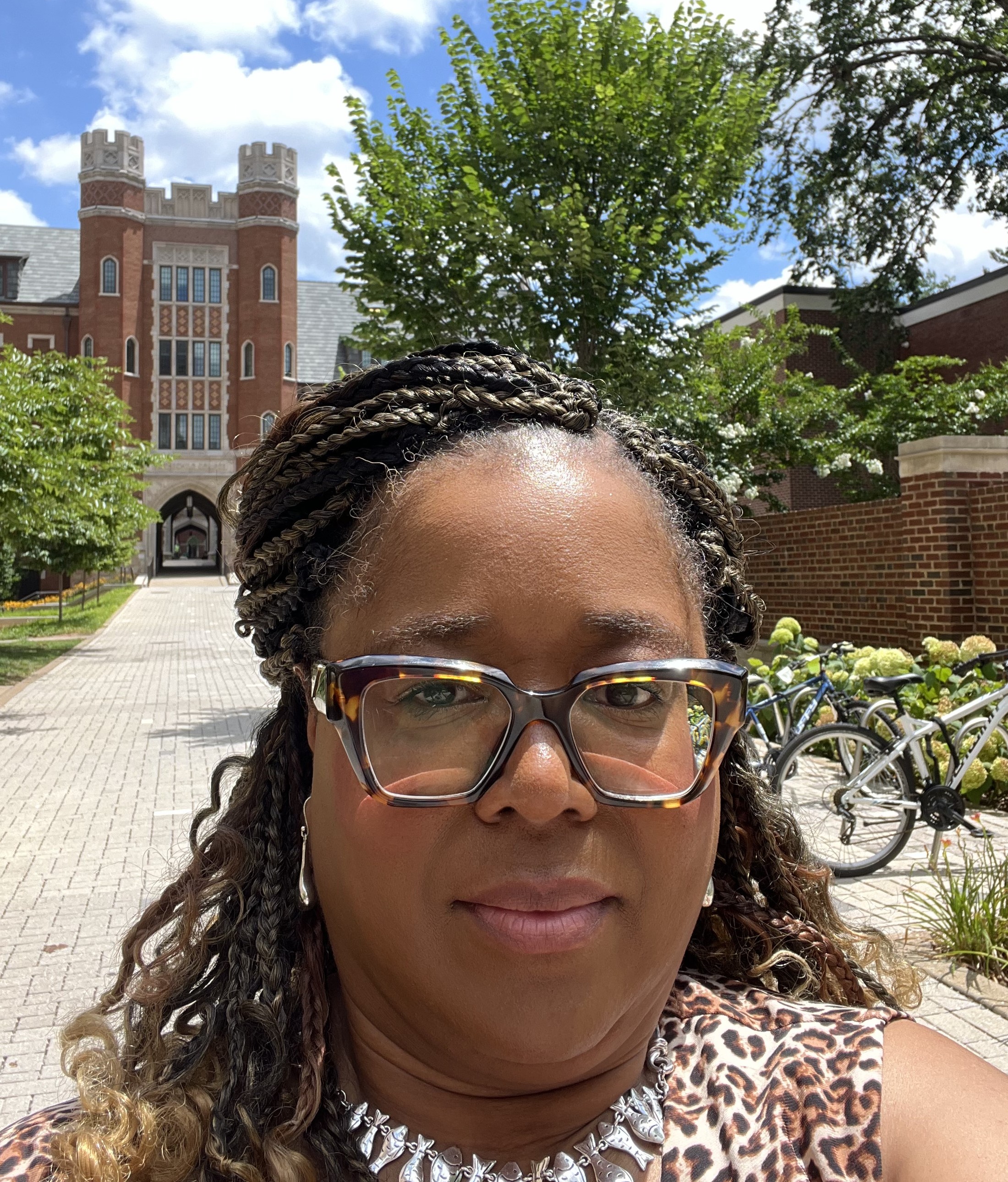
From time to time, I find myself reflecting on my career in the field of Education which spans some 30 years and includes teaching high school Spanish in inner city Nashville, a stint as the Coordinator of Minority Teacher Recruitment Center at Western Kentucky University, where I recruited BIPOC students into the College of Education, administrated and awarded the state’s teacher education scholarship, provided support services such as advising and Praxis I test preparation, and designed a residential week-long program for middle schoolers and a two week residential program for freshman education majors.
During my tenure at IRT over the last two decades, recruiting at universities across the country, and serving as a SOP and IRT Advisor, writing curriculum, and co-developing our robust advising program, among other duties, I have staunchly advocated for my own and colleagues’ professional development and personal growth. I welcome the challenge that learning something new can bring, the opportunity to interact with others, and the time to think about old problems in news ways. Moreover, as a perpetual teacher and learner, I find myself regularly contemplating the ways that I can become a more effective advisor by deepening my knowledge of the students IRT serves and, while simultaneously, developing my understanding of content knowledge across various fields, technology, the digital humanities, and place as it pertains to the geographic home countries of IRT Scholars’ families and the diverse linguistic and cultural backgrounds that they and our scholars possess. For me, all that I learn informs the way that I show up to mentor and counsel students.
Consequently, when I came across the opportunity to study in a week-long Summer Institute titled Towards a More Equitable and Inclusive Digital World in Latin America, sponsored by the Center for Latin American, Caribbean, and Latinx Studies at Vanderbilt University and in collaboration with Tulane’s Stone Center for Latin American Studies and Arizona’s Center for Latin American Studies, I was ecstatic and knew that I wanted to participate and, so, I applied. During the week of June 24th, 2024, I and approximately 17 other teachers took part in several learning endeavors. First, we were introduced to the Slave Society Digital Archive (formerly Ecclesiastical and Secular Sources for Slave Societies) directed by Dr. Jane Landers, a professor of History at Vanderbilt University who studies colonial Latin America and the Atlantic world. The Slave Society Digital Archive is a rich repository of ecclesiastical records of some 750,000 individuals, largely Africans and their descendants, alongside records of Indigenous and Chinese individuals. Often, these records have been digitized from the original baptism records found and recovered in church basements and/or other storage locations in the United States, Cuba, Brazil, the Dominican Republic, and Benin. Dr. Landers informed us that many of the adult records provide the occupation of enslaved individuals, their parents’ names, those of their godparents, their place of origin, and their profession. of the adults. She also shared with us that many of these manuscripts are in poor condition, are burned before they can be salvaged, and/or are destroyed in natural disasters such as floods and hurricanes. The paper in some manuscripts in like lace, demonstrating the fragility of records that are hundreds of years old and the urgency of digitizing such sources of knowledge.

Another session included a Zoom discussion with Kaê Guajajara, an indigenous artist who lives in Rio de Janeiro, Brazil. While Kaê identifies as an Indígena favelada (Indigenous slum dweller), she resists the colonial mold and rejects conformity. She spoke to us about her activism and work advocating for plural Indigenous identities, combating identity stereotypes, erasure, and the enduring legacies of slavery. She is actively fighting for Indigenous communities and does so in a several ways including maintaining a presence on social media:
We visited the Latin American Ethnobotanical Garden on Vanderbilt’s campus and learned about flora and fauna from Latin America. I then created a podcast in wevideo and described the benefits of Amareth or Bledo in Spanish, which is a plant and source of vitamin C. Bledo appears in the Codez Mendoza, an Aztec codex (manuscript) written as early as 1541. Later in the week, we ventured to the Nashville Public Library and watched a puppet show regarding the Ancient Maya Tales from the Popol Wuj. Popol Wuj or Popel Vuh, is a text that documents the creation story of the K’iche community of Guatemala who also inhabit the Mexican states of Chiapas, Campeche Yucatán, Quintana Roo, and areas of Belize, Honduras, and El Salvador.
An exhibit at the Frist Museum and titled ¡Printing the Revolution! The Rise and Impact of Chicano Graphics, 1965 to Now was an incredibly informative visual representation that provided a history of Chicano protests through graphic art.
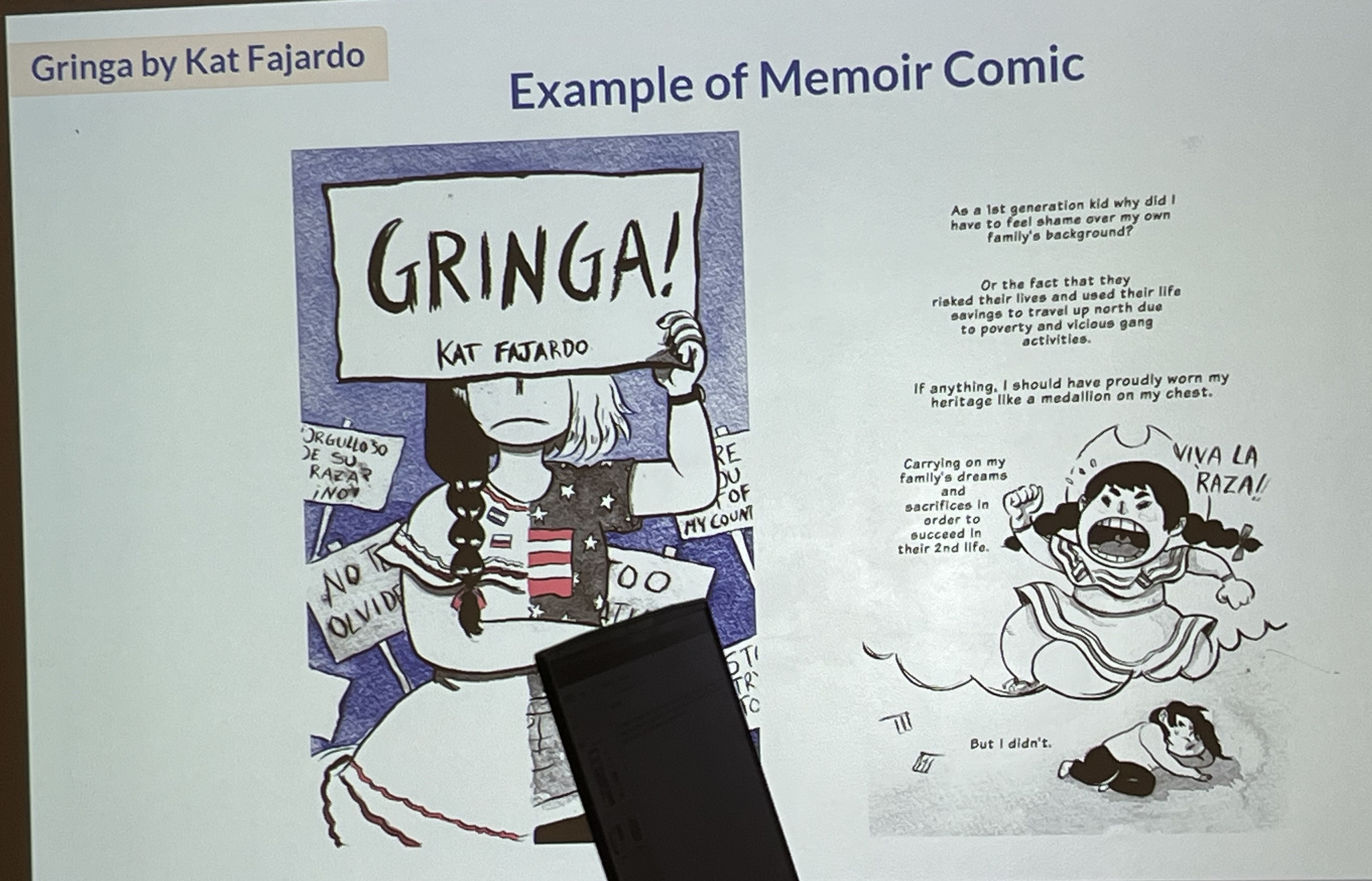
Other activities included a visit to the National Museum of African American Music so that we could learn about ways to incorporate Afro-Latine music in the classroom setting while utilizing interactive and digital resources. We ended the week with a conversation and book signing with Kat Fajardo, author of the Américas Award for her graphic novel, Miss Quinces. Kat spoke with us about her process of writing and illustrating graphic novels. This Institute provided me with new colleagues, one of whom I had first meet when I participated in an Institute in Cuba and a sustained immersion in the digital humanities, which I hope to engage further. One source of professional development for K-12 teachers is the National Endowment for the Humanities which typically lists seminars in January.
Do share any opportunities of which you are aware. In the meantime, to IRT alums everywhere, happy learning and joyful teaching!
Leislie Godo-Solo, IRT ’91
Education Specialist, Institute for Recruitment of Teachers
 Institute for Recruitment of Teachers
One thought on “Professional Development and a Learning Opportunity for Teachers”