
Leislie Godo-Solo, IRT ’91
Education Programs Specialist, Institute for Recruitment of Teachers

Recently, I was chosen to participate in the 4th annual cohort of the Phillips Academy Head of School Leadership Development Program (HOS-LDP) alongside 11 other individuals from the following schools: Pomfret School, St Paul’s School, Deerfield Academy, Lick- Wilmerding High School, and Phillips Academy. The 8-month program consisted of an in person, two-day leadership retreat, twice-monthly cohort meetings with guest lecturers and readings, 10 hours of professional coaching, the opportunity to enroll in a leadership course taught by Harvard’s online Business School, a capstone project and presentation that addressed a departmental or institutional priority, and a closing dinner including a certificate award ceremony.
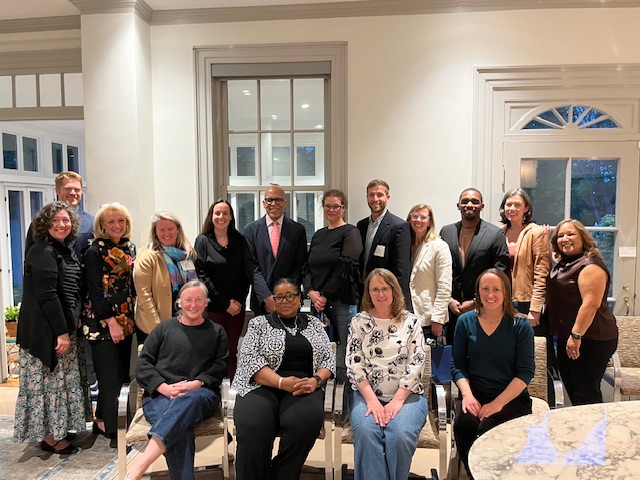
Participants from Phillips Academy Head of School
Leadership Development Program (HOS-LDP)
One of the first articles we read was titled VUCA: Volatility, Uncertainty, Complexity, and Ambiguity, an acronym created by the Army War College and while we often discuss these terms haphazardly, they resonated with me viscerally because of the many complex changes coming from the federal government that greatly impact IRT’s work to support students as they apply to graduate school in fields that continue to be maligned and, even, dismantled including the humanities, social sciences, and education. This assault has been ongoing for years, particularly around curricula decisions. However, during 2025, we observed the dismantling of the Department of Education and the Division of Civil Rights, alongside the defunding of education from the K-12 to post graduate levels in rapid succession. These changes made VUCA real for me in ways that were unexpected and jarring.
I was further intrigued by Stephen Zrike’s, IRT ’01, thoughts about leadership and the need for the MCAS exam in Massachusetts. I found Kelvy Bird’s discussion regarding Theory U, a framework that considers our blind spots as leaders and supports implementing systemic change by C. Otto Scharmer and his Iceberg Model, which is the idea that what we see is only 10% of what is happening, fascinating. The other 90% is under the surface and consists of visible behaviors, structures, paradigms of thought, and sources of inspiration. In our current reality and when thinking about change, we must consider what behaviors and events we are seeing. What structures are shaping those behaviors and events? What beliefs and mental models are shaping the structures? What levels of awareness do we need to be operating from? In planning for our future vision, we should determine what behaviors and events we would like to manifest as outcomes. What structures will be needed? What beliefs and mental models will support the shift? What levels of awareness do we need to operate from?
The IRT Effect: Charting IRT Scholars who have completed Ph.D. degrees
During my Leadership Principles course, I studied concepts such as the tools of leadership, criteria of team effectiveness, the five aspects of team culture, and effective ways of launching strategic change, among others. I was excited to learn about Leadership Imprint, which describes seven dimensions of leaders that include authenticity, competence, humility, resolve, warmth, elevation, and faith- the elements of how leaders show up in each space. I completed a 360-degree Emotional/Social Competency Inventory that provided me with insights regarding perceptions of me as a leader and areas of growth as I strive to become a stronger leader.
The objectives of our capstone project were to identify and address an institutional priority, seek feedback from relevant department members and/or constituents who would be affected by the priority, and work through the implementation process of the priority. I wanted to document the number of IRT Ph.D. alums in a visual snapshot, which would highlight IRT’s efficacy in supporting scholars in their admission to graduate school. In researching and writing The IRT Effect: Charting IRT Scholars who have completed Ph.D. degrees, I wanted to create an interactive visualization that I believe would be a more effective way to tell a compelling IRT story to our alumni, the current cohort, donors, foundation leaders, and advisory board members
As the saying goes, a picture is worth a thousand words. Additionally, each year, current scholars ask to speak with graduates in our program who have a Ph.D. degree in this or that field and we must search through the databases manually to collect this information. My project would allow students to do their own searches without involving the IRT staff. Moreover, I chose this topic because I am interested in the digital humanities, an interdisciplinary field that allows individuals to apply digital methods to the study of the humanities and education.
My involvement in the Leadership Development Program also stemmed from my desire to embrace life-long learning, as I believe that leadership development is an ongoing endeavor. The best leaders are always adapting and working on their emotional intelligence. In these ever-changing times and in the day-to-day when many decisions and tasks come my way, learning to manage them effectively, while supporting others, whether my mentors or colleagues, is pivotal.
 Institute for Recruitment of Teachers