
by Amanda Bennett, IRT ’16
Writer | Educator | Researcher | Poet Laureate of Carrboro
There is a direct line from IRT to the backyard of my Durham home.
Years ago, IRT taught me how to do something that seems simple once you know how, but can feel nearly impossible when you do not: navigate the infrastructure of graduate education. I learned how to prepare for the GRE, how to build a graduate school application, how to understand the admissions process, and how to request application fee waivers so that money did not immediately determine which opportunities were available to me.
Those skills eventually helped me enter Duke University’s Literature Ph.D. program, where I studied critical theory, Black feminist thought, spirituality, literature, and the ways Black people use imagination to repair ourselves and build lives under difficult conditions.
But something else happened because I came to graduate school: I came to Durham.
Over time, Durham became more than the place where my university happened to be located. It became a home. It became the place where I found writers, artists, organizers, neighbors, gardens, bookstores, libraries, porches, and other people trying to figure out how to live well together. The intellectual questions I had once encountered primarily through books began showing up everywhere:
What does care require?
Who gets access to knowledge?
What makes a space feel safe enough for people to create?
How do ideas circulate?
What happens when the institution cannot, or will not, build the world we need?
These questions now shape my work as Carrboro Poet Laureate and as a Black feminist public humanist. Increasingly, I understand poetry not merely as an art form, but also as a civic technology of care. And I understand public humanities work not simply as bringing scholarship “to the community,” but as helping people build the infrastructure through which they can study, create, gather, publish, teach, and circulate knowledge for themselves.
That distinction matters.
I have attended plenty of events where people gather beneath banners proclaiming community, liberation, creativity, or inclusion, only to leave two hours later with their material lives completely unchanged. I am less interested now in whether an event is impressive than in a more basic question:
When people leave the room, what has moved?
Has money moved? Has an opportunity moved? Has useful knowledge moved? Did someone meet a collaborator? Did a young writer learn where she can submit her poem? Did an artist get paid? Does someone understand their own work more clearly? Is there now a next step where there was not one before?
This summer, I saw what that can look like while working with G.L.O.W. Girls, a program founded by high school student Vianna Fornville to create artistic space for girls who do not always feel that their full selves are welcome elsewhere.
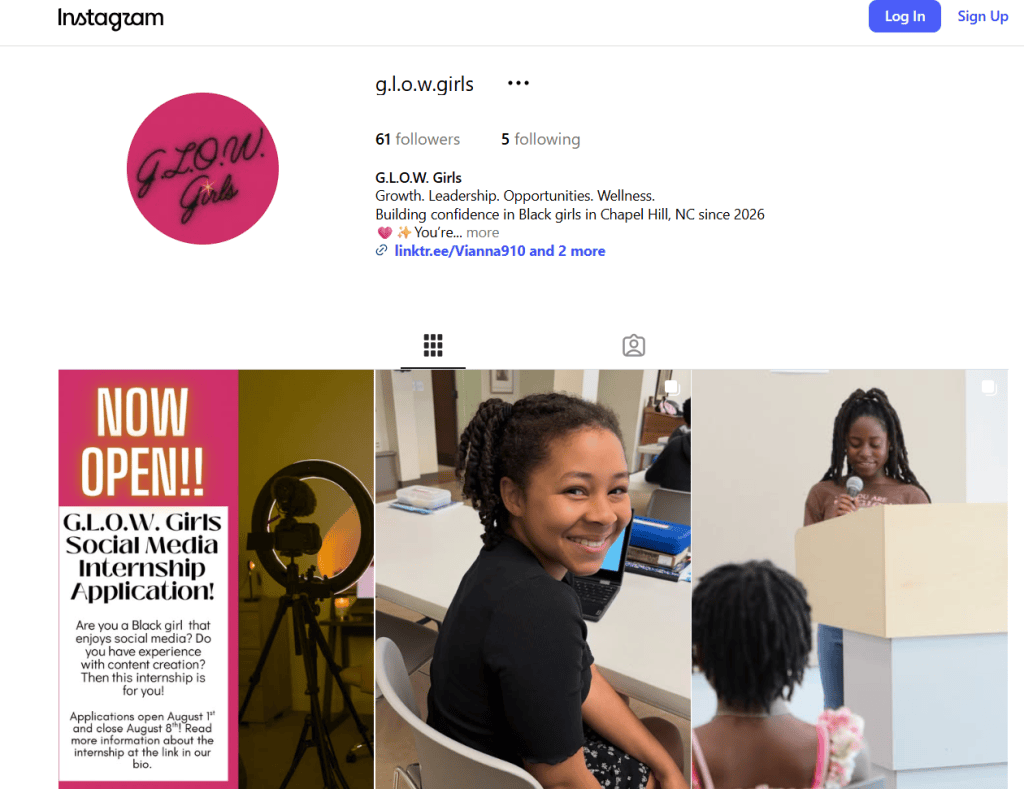
I judged their inaugural poetry contest and listened as young Black girls wrote about beauty, hair, racism, self-worth, and the people they were becoming. Their poems were beautiful. But I kept thinking about what happens after a young person tells the truth.
Applause matters, but a pathway matters more. I had experienced that truth firsthand through receiving support from IRT, and I realized it was my opportunity to create similar pathways for younger people.
So I began sending opportunities onward. A young poet’s work moved from the contest into The Carrborean. G.L.O.W. Girls poets entered the West End Poetry Festival. Their writing began moving into literary and media spaces where they could be encountered not as an adorable youth feature, but as writers whose work belonged in public.
The philosophy is simple: write the poem. Share the poem. Be taken seriously. Publish it. Read it publicly. Get paid. Meet another writer. Receive another opportunity.
That, to me, is infrastructure.
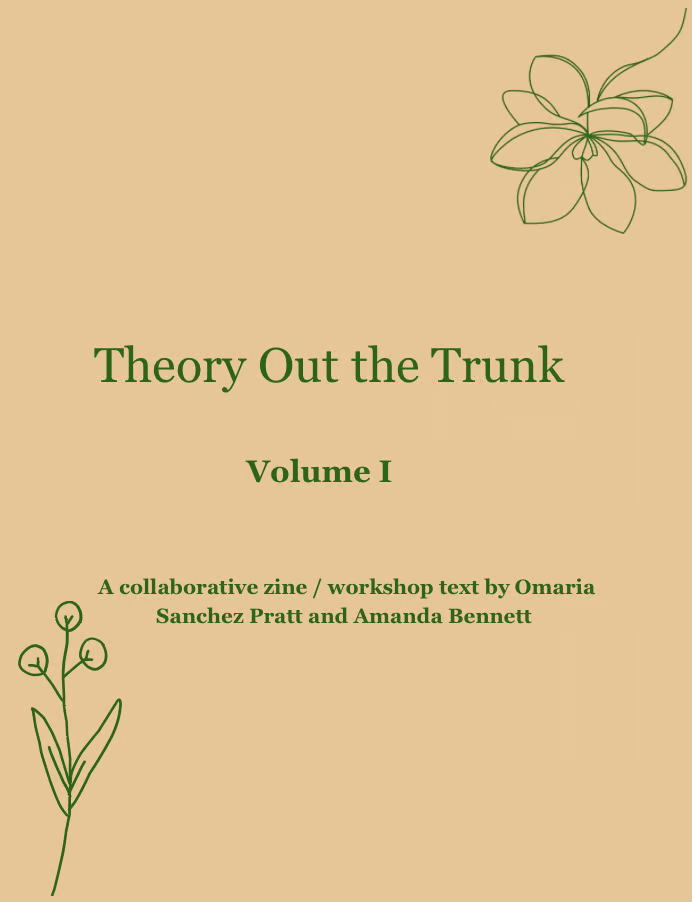
It is also the principle behind Theory Out the Trunk, the literary and intellectual ecosystem I am building with my partner, writer and teaching artist Omaria Sanchez Pratt. We are interested in teaching artists and intellectuals not only how to produce creative work, but how to build the conditions that allow intellectual and artistic life to survive outside traditional institutional spaces.
Our experiments currently take three interconnected forms.
Backyard Writing Revival is our experiment in community-based education. Across four weeks, writers and organizers gather at our home in Durham to move through a creative cycle:
THEORIZE → GENERATE → REVISE → WORKSHOP
We read Black feminist theory, fiction, poetry, interviews, and craft writing. But our central questions are not about demonstrating mastery of those texts. We ask: What is this about? What are you channeling? What is happening? What is this preparing you to become? What are you building?
At a moment when access to Black, queer, trans, feminist, and community-engaged humanities is narrowing in many institutional spaces, the backyard becomes a small school.
Sweetshrub Reading Series addresses another piece of the ecosystem: gathering. We created Sweetshrub to platform emerging Southern Black writers in intimate community spaces and to build a reading culture rooted in relationship rather than celebrity. I want people to encounter an artist’s work, certainly, but I am equally interested in what becomes possible because those particular people were in a room together. Our first gathering on October 20th is happening partially due to generous grant support from the North Carolina Poetry Society.
And Theory Out the Trunk itself addresses intellectual distribution. Our zine work asks what happens when we stop waiting for traditional publishing institutions to determine whether an idea deserves an audience. The name comes from a familiar Black Southern economic tradition: selling plates, music, beauty products, books, bootlegs, and whatever else we have made directly to our people. “Out the trunk” means the infrastructure may be informal, but the knowledge, labor, imagination, and value are real.
Taken together, these projects form a small circuit.
Backyard Writing Revival creates a place to study and make.
Sweetshrub creates a place to gather and listen.
Theory Out the Trunk creates a way to publish and circulate.
None of this requires pretending institutions have no value. My own life disproves that. IRT changed my trajectory because people understood that access is not an abstract value. Access sometimes looks like teaching somebody how to take a standardized test. It looks like explaining an application process that was never designed to be intuitive. It looks like a fee waiver.
Those small interventions can alter a life.
I entered Duke because people helped me learn how the machinery worked. I spent years acquiring skills in research, teaching, grant writing, project management, editing, program design, and critical theory. Now I am interested in what happens when those skills become portable.
I learned grant writing so I can bring money into rooms where artists are normally expected to work for free.
I learned how to teach theory so I can help someone interpret their own life, not simply a text.
I learned how institutions distribute resources so I can imagine other ways of circulating them.
And perhaps most importantly, I learned that home itself can become an intellectual space. bell hooks wrote of Black women’s homemaking a site of resistance, a place where Black people could restore the dignity and humanity the outside world attempted to take from them. I am interested in extending that idea outward. A backyard can become a seminar room. A bookstore can become a cultural archive. A reading series can become a professional network. A zine can become a curriculum.
The humanities are most alive to me when they give people something they can use.
I still believe in scholarship. I still believe in the poem that changes the temperature of a room. I believe in difficult books, close reading, archives, theories, and ideas that take years to understand.
But I am increasingly interested in what we build around them when we ask brave, interesting questions:
What if the workshop becomes a small school?
What if the reading becomes the place someone meets an editor?
What if the zine allows theory to travel into somebody’s kitchen, organizing meeting, classroom, or creative practice?
What if the person who learns how the system works teaches someone else?
Perhaps that is one way of understanding the responsibility of public humanities work.
Receive the knowledge.
Build the room.
Then send it on.
Interested in learning more? Connect with Amanda below:
Amanda Bennett Studio: amandabennettstudio.com
Field Notes on Substack: http://amandabennett.substack.com/
Sweetshrub Reading Series: https://bit.ly/sweetshrub
West End Poetry Festival: https://www.carrboronc.gov/2781/West-End-Poetry-Festival

