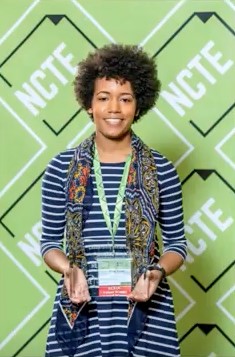
2022 IRT Summer Workshop Faculty

As we head into July, the IRT virtual Summer Workshop Faculty and staff are busy finalizing curriculum, organizing alumni and professional panels, consortium liaison meetings and other events throughout the upcoming month. Join us in welcoming this year’s summer faculty!

Renée Wilmot, IRT ’12, ’17

My name is Renée Wilmot, I use she/her pronouns. Currently, I am a Ph.D. candidate at Michigan State University in the Teacher Education program. My research interests include (1) the historical legacy of Black women as educators and activists in the Black community and (2) Black girls’ practices of thriving and resisting in white supremacist schooling structures. I am originally from Virginia and I am a former secondary English/Language Arts teacher.

Advice for the current cohort
Do your best to commit 100% of yourself. Take advantage of this opportunity – take risks and push yourself.

Suggested Reading

  • Ebony & Ivy by Craig Steven Wilder
  • White Architects of Black Education by William H. Watkins
  • White Rage by Carol Anderson 
  • Sister Outsider by Audre Lorde 
  • The Fire Next Time by James Baldwin
  • Black Feminism in Qualitative Inquiry by Venus E. Evans-Winters


My biggest takeaway from my IRT experience was that this is a safe space for me to push myself, risk failure, and then get up to try again. I had never been in a space where I could “mess up” academically, experiment with time management and reading strategies, and take risks. 


My grounding quote for this year: “We protect and nurture our collective well-being. We strive to make our home place a positive environment for everyone. We all agree that integrity and care enhance all our lives.” (hooks, ,p. 101) 

My current favorite song: “Dim All the Lights” by Donna Summer 

Continue reading “2022 IRT Summer Workshop Faculty”

IRT Alumni Mentor Phillips Academy’s Students of Color and Participate in MLK Workshop

by Leislie Godo-Solo, IRT ’91


Since November of 2020, Leislie Godo-Solo, IRT ’91 has served as one of the faculty advisors for the Af-Lat-Am Mentoring Program (AMP) at Phillips Academy which has a membership of 104 students of color.  Leislie, along with the input of six student coordinators creates and plans programming that benefits students’ personal and academic growth.  During the current academic year, Leislie and the coordinators hosted Ms. Warner and Mr. Coy of the Academic Skills Center who discussed study strategies and, more recently, during the MLK Jr. holiday weekend, IRT alumna, Kelicia Hollis Jessie ‘11 was invited by the organization and held a workshop titled AMP Mentoring Reset:  Going Back to Basics, an interactive session in which the mentors learned ways to be more intentional and effective in their interactions with their mentees.  Additionally, Aleena Kibria, one of IRT’s Student Advisory Board Leaders conducted a MLK Jr. Workshop titled “What Is a Bad Hair Day?  In this presentation, Aleena and her peers discussed how often students think about their hair, Eurocentric beauty standards, the politics of hair, hair discrimination, and legal efforts to rectify hair discrimination in schools and the workplace.  Aleena went a step further for her presentation and interviewed Phillips Academy and IRT students Kevin Pajaro-Mariñez, IRT’15 LaKisha Simmons, IRT ’02 and Elyx Desloover, IRT’ 21 about their feelings regarding their hair. Check out their discussion on YouTube.    

Congratulations Aleena on a dynamic and well-received MLK Workshop!

Alumni Profile: Kevin Pajaro-Mariñez, IRT ’15

Kevin Pajaro-Mariñez, IRT ’15 shares his journey with the IRT community in this interview with Brittany Zorn, IRT ’13, Arts and Sciences Programs Specialist, IRT

In an era when there is so much demand on our time, attention, and energy, nothing soothes the soul like returning to the simple pleasures life has to offer, like celebrating our community. Despite an endless and unprecedented amount of challenges this past year, there has also been an endless amount of accomplishments across the IRT alumni network. More broadly, there has also been an unprecedented amount of interest in issues of justice, equity, diversity, and inclusion (JEDI) in this country since the murder of George Floyd, Breonna Taylor, and Ahmad Aubrey sparked a series of protests for racial justice last spring.

Continue reading “Alumni Profile: Kevin Pajaro-Mariñez, IRT ’15”

Alumni Accolades – April 2020

~2018 Cohort~

(L-R) Christopher Perez, Program Director, Office of Graduate Diversity & Inclusion at the University of Maryland and Briceno Bowrey, IRT ’18 currently in his first year of doctoral studies in History at the University of Maryland. #IamIRT

~2017 Cohort~

Mariahadesse Tallie, IRT ’17
Mariahadesse wrote her first children’s book entitled, “Layla’s Happiness,” published by Enchanted Lion Books. She is currently a Ph.D. student at Brown University.


Continue reading “Alumni Accolades – April 2020”

Monthly Matters in Black History—Jessica Samuel, IRT ’15

monthly matters image

Teaching Beyond a Colonial American Blackness or The Costs of being Black and not really American in the Classroom

By Jessica Samuel, IRT 15
American & New England Studies Program
Boston University

One of the most fascinating (and disheartening) phenomenon I experienced as a first–year teacher in an urban public school was the way in which the Black students I taught assumed that because I was Black—in addition to being a woman, “foreign,” and young—I knew less than my white colleagues, even when those colleagues and I shared similar demographics across gender, age, educational background, and professional experience. Comments such as “she doesn’t know what she’s talking about,” “what the hell is she saying” or even, “she can’t teach” alerted me to the ways in which my identities had predetermined my capacity, and by extension, that of my students. It became increasingly clear to me that years of indoctrination had led my students to think the way they did about Black intelligence.

Even more than thinking intelligence was colored everything but Black (or Brown), my students had also learned that “American” was the most reliable and legitimate label from which to expect knowledge and skill. As an Afro-Caribbean U.S. Virgin Islander—whose relationship to Americanness is fraught—it had become clear to me that my students had inherited a white supremacist, imperialist, patriarchal framework for being in the world.[1] Who my students believed was most qualified to teach them was not simply about years of experience in the classroom but also about years of experience being American. How American I could be directly informed my students’ ability to respect me in the classroom. That I had a slight accent, was born in a place they’d never heard of, and happened to also be Black meant that I would have to work overtime to establish professional authority in my classroom.

Continue reading “Monthly Matters in Black History—Jessica Samuel, IRT ’15”