Exploring Russian and Slavic Languages

Leislie Godo-Solo, IRT ’91 recently spoke to A’Yanna Solomon, IRT’21 to discuss her work and interests

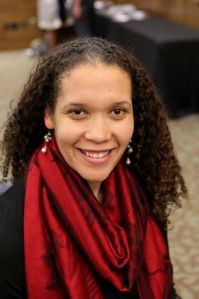
On a regular basis, I am captivated by the innovative, interdisciplinary, and relevant scholarship that IRT Scholars are engaging.  This sentiment also rings true as it relates to the scholarly work that A’Yanna Solomon, IRT ’21 is pursuing as a second-year graduate student in the Slavic Languages and Literature Department at the University of Michigan. 

A’Yanna’s trajectory and interest in Russian and Slavic languages originally began in East Baltimore, Maryland, where she grew up listening to hip hop music which she says resonated with her, much in the same way that Black culture did.  A’Yanna knew that she wanted to study Russian because she was fascinated by its phonetics and written script during her youth.  Upon enrolling at Goucher College, she majored in Russian and Spanish Languages.  Because the Russian program was being phased out of existence at Goucher College, one of A’Yanna’s professors also introduced her to Slavic Studies, Eastern European, and Eurasian Studies which have gained more cache as the focus on Russian language decreases in the field.  Within Russian Studies, A’Yanna focused on comparative marginalization and popular culture and the ways that the LGBTQ communities in Russia resisted homophobic queer phobic legislation.  In what ways did these communities create and maintain community?  This preoccupation with marginalization stemmed from her own treatment as an outsider studying Russian language.  Often, a student would lean over quietly and ask her, “This is intermediate Russian, right?”  Fifteen minutes would pass, and the same student would respond, “So, do you like speaking Russian?”  “Yea, I do, I do.” 

Continue reading “Exploring Russian and Slavic Languages”
Profile: Brighid Dwyer, IRT ’01

Redefining networking
I used to think of networking as a “dirty” word that conveyed images of people wearing stiff suits, holding cocktails, and pretending to be someone they are not in order to get a job or secure money for a business deal. While this is still a pervasive image that comes to mind when I think about networking, the IRT has caused me to think about networking in much more applicable, authentic, and holistic way. This is because the IRT focuses on the authenticity of the network, not the false pretenses that come with hollow actions of networking.

Continue reading “Profile: Brighid Dwyer, IRT ’01”

Alumni Host Info Session at the University of Michigan

This past October, IRT alumni welcomed about 20 prospective applicants during an information session at the University of Michigan. IRT alumni shared their perspectives and insight into the program.

The IRT panel included the following:

Aesha Mustafa, IRT ’16—Aesha is a 2nd year Ph.D. student in Higher Education at Michigan State University. Her research interests explore higher education’s role in promoting students to develop a propensity toward civic engagement, diversity, equity, and inclusion. Aesha hopes that higher education institutions can impart all students, regardless of academic discipline, with the tools to respectively and critically engage in an increasingly multicultural world.

Denise Galarza Sepúlveda, IRT ’91—Denise is the Director of the University’s office of Community-Engaged Academic Learning (CEAL) where she works with faculty to create transformative learning opportunities for undergrads and trains future faculty in community-based learning. Prior, she was a professor of Latin American Literature for over 10 years at Lafayette College in PA. She has received national and university awards for her research, her teaching and her mentorship of underrepresented students. She also volunteers every Saturday, teaching Latino children in the ENL literacy program.

Continue reading “Alumni Host Info Session at the University of Michigan”