
January 2026
As part of a new initiative, IRT Executive Director LaShawnda Brooks will be selecting an alumni book to read periodically. She encourages all alumni to share in this endeavor, providing commentary on the book in the comments section below or by emailing. LaShawnda’s commentary is included at the end of this post.

Dr. Monica Muñoz Martinez’s The Injustice Never Leaves You: Anti-Mexican Violence in Texas is this month’s selection.
Monica was an IRT Intern in 2005 and continued to be involved in the IRT as part of the IRT Summer Workshop Faculty for the subsequent six workshops.
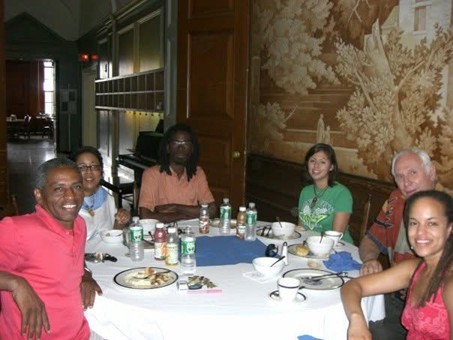
Monica (third from the right) during one of her first IRT Summer Workshops.
She is currently an associate professor in the Department of History at the University of Texas. Not only an educator and public historian, but Monica is also an award-winning author of The Injustice Never Leaves You: Anti-Mexican Violence in Texas, (Harvard University Press Sept 2018). Many national media outlets feature her research. Her current project, Mapping Violence, focuses on recording cases of racial violence in Texas during 1900 – 1930.
Monica was named a 2021 MacArthur Fellow. The MacArthur Fellowship is unrestricted and unofficially known as the “Genius Grant.” The MacArthur Foundation considers that the fellowship “is not a reward for past accomplishment, but rather an investment in a person’s originality, insight, and potential.”
Monica received her master’s degree from Brown University and her Ph.D. from Yale University.
###
LaShawnda’s Commentary
Over the last few months, I have struggled and toiled while reading The Injustice Never Leaves You. An apt title for a book that describes the violence in establishing the state we now know as Texas through oral histories. I was completely unfamiliar with this history; my only memory of the Texas border was formed through shows like Walker, Texas Ranger. Imagine my horror as I navigated the atrocities articulated by Dr. Monica Muñoz Martinez.
The one enduring question I have – how do you navigate documenting this history emotionally and mentally? How do we support community and memory to encourage healing and truth-telling? History is not an easy endeavor to extract, and these stories hurt me to read – I could not imagine experiencing them through the recounting of memory. In the end, it left me with a deep sense of appreciation and resolve for the work of IRT Scholars.
While this book is incredibly difficult to read (I switched to the audiobook so I could walk while engaging with the text), it is a must-read for everyone. At a time when we are witnessing anti-immigrant violence, history once again reminds us of the power of the state and those around it in establishing periods of terror.


2 thoughts on “Alumni Book Spotlight”