
On May 18th, the IRT welcomed the 36th consecutive IRT Cohort of 104 scholars.
Despite the current and daunting educational climate in the United States, now, IRT Scholars remain steadfast in their desire to expand scholarship in their respective fields and make lasting changes to our K-12 and collegiate landscapes as diverse individuals and scholars who will push against traditional narratives that are perpetuated in their respective fields. They are excited about their IRT journey, the reasons they do this work, and the trajectory of their careers. They share their personal and academic dreams below and ruminate on why they engage in the messy work of education.
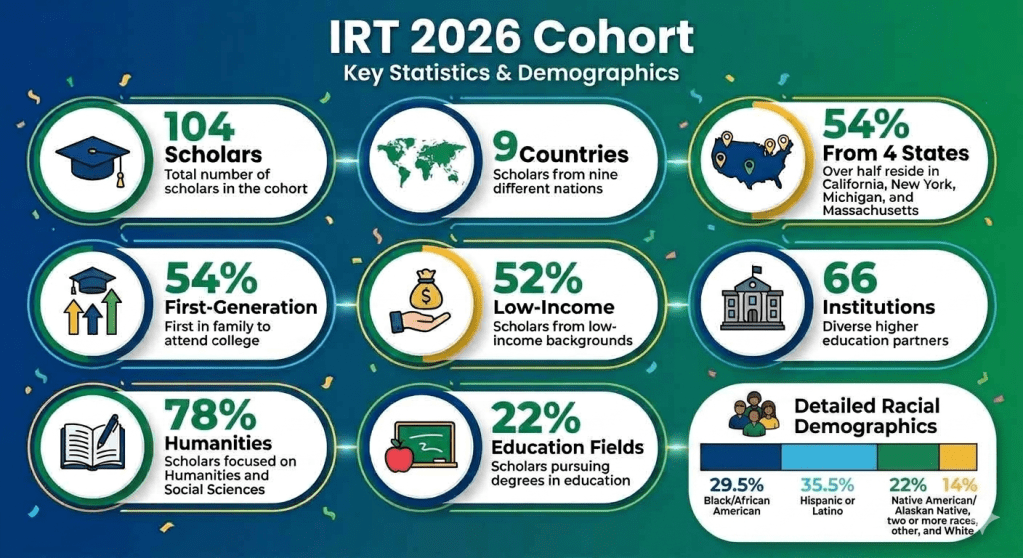
- 29.5% identify as Black/African American
- 35.5% identify as Hispanic or Latino
- 22% identify as Asian
- 14% identify as Native American/Alaskan Native, two or more races, other, and White.
- 54% identify as first-generation
- 52% identify as low-income
- 38% are first-generation and low income
- Scholars represent 21 states, DC, Puerto Rico, and 9 countries
- 54% live in four states including California, New York, Michigan, and Massachusetts
- 78% are pursuing fields in the humanities and social sciences while 22 % are pursuing fields in education
- Scholars attend 28 public universities, 32 private colleges/universities, 4 HBCUs, and two international universities.
“I do this (work) because I believe knowledge is powerful, but I also believe we must ask who gets to decide what counts as knowledge. Too often, the wisdom of Black communities has been dismissed, extracted, or ignored. I want my work to help tell a different story. One that recognizes Black people not simply as participants in educational systems, but as creators of knowledge, theory, and possibility.
And I do this (work) for liberation. Not liberation as an abstract idea, but liberation as the ability for people to know themselves, define themselves, tell their own stories, and build educational futures rooted in dignity, self-determination, and collective flourishing. That is the work I hope to contribute to. That is who I do this for.”-Judah
“I am passionate about the analysis of visual culture and believe that visual literacy is needed more than ever in the age of social media and AI and growing social inequities.
Through my research, I seek to bring visibility to these inequities and the growing violence towards Black and Brown people, as well as the LGBTQA+ community, as a means to advocate for our existence and right to thrive. In truth, my research and writing have returned a sense of agency to my life during these uncertain times.”-Leslie
“I don’t always know why I do this work; maybe it’s because thinking all day comes naturally to me, maybe it’s because college has always been valued in my home. Maybe it could also be that I don’t want to let the people down who have come before me and paved the way for these opportunities to be possible. I am fortunate to be in a space where abstract thinking is valued, and the art of discussion is championed in a way that molds societies. I also know that the ability to do this work is a gift, and I seek to understand the true depths of what I can accomplish if I truly dedicate time and my mind to it.”-Leon
“I do this work because there are Black, Indigenous, Latinx people grieving preventable losses caused by institutional violence. I do this work because there’s a little Black girl within myself screaming for her ideas to go beyond thoughts. I also work so that those after me may see themselves more plainly in the academy, in the canon, and in the fight towards liberation. I also work for my mother, grandmothers, great-grandmothers, and more, specifically for the dreams deferred, dreams that continue to live through me.” -Adrianna
“I do this work because our existence is both resistance and political. My work is personal because I am a first-generation Latina college student and among those personally impacted by the current U.S. immigration climate. Whether it is research or being involved within these institutions in social justice work, I do this not just for undocumented and mixed-status immigrants, but alongside them. Co-creating knowledge that challenges current policies and champions educational equity in higher education.”—Violeta
“I do this for my students — to become a teacher that can better serve my students who are immigrants, refugees, Black, Brown, multilingual, underprivileged, underrepresented, and more; because the state has already decided that teachers of color are disposable, that my students’ families are disposable, and that my students themselves are disposable when they are only five, six, seven years old. I do this for other K-12 educators so we can tend to each other and try to sustain a profession in a system that is actively working against us. This work is how I care for my community.”-Valerie
“I do this for the first-generation, mixed kids who don’t know yet that they have a future with everything they’re going to do. Because I was that kid.
I moved through four high schools in three years, between Massachusetts and Florida, between Spanish at home and English at school, between Puerto Rican and Cape Verdean, between systems that never quite knew where to place me. Nobody handed me a map. Nobody sat me down and explained what a fellowship was, what graduate school looked like, or how education policy actually gets made. I figured it out late, I figured it out unevenly, and honestly, I’m still figuring it out.
So, I do this for the version of me who didn’t know any of this was possible. And I do it for the kids who are sitting in that same seat right now, code-switching through their day, carrying two or three cultures on their back, brilliant in ways the system isn’t built to notice. They have a future. They just need somebody in the room who remembers what it felt like not to know that yet.” – Nasariah
###

